aquariophil

Mexico 2009 - Oaxaca, Chiapas, Veracruz

Some brief insights into the Mexican ichthyofauna

Sierra de Juárez, Oaxaca

The first stage was a kind of cold temperate fog forest located in the very heart of the Oaxaca state, the Sierra de Juárez. It’s on the way south between Oaxaca city and Salina Cruz. If you are heading westwards you are crossing an Atlantic-Pacific watershed. The mountain range reaches 2750 m in high stretching from NW to SE. On the NE slope of the mountain range there are plenty of tributaries to the Rio Coatzacoalcos running all the way up to the Caribbean Sea, on the opposite SW slope there is the Rio Tehuantepec basin. The latter empties into the Gulf of Tehuantepec (Pacific). 

Oaxaca Fog Forest
Oaxaca Fog Forest

Moses and ferns are thriving in this moist environment. They are growing virtually everywhere, here on vertical rough rocks. Almost any surface is covered by them.

Oaxaca Fog Forest

Water is flowing everywhere in Oaxaca Fog Forest. Small streams coming up from the rocky bottom flowing along the road sinking into the soil, later accumulating to rivers or just evaporating anywhere. There plenty of wild rivers running through the forest. I fished in more than six location. I did not catch any fish although some locations are really smelling like Priapella. Probably my equipment did not meet the unique conditions of hill streams. 

Massive clouds of fog are caught in the Sierra de Juárez canyon. It was permanently raining perpetuating the moist environment. The speed of fog clouds moving was impressive. It took only seconds from a cloudy view to an excellent far sight view. 

Leaving the road MEX190 I was trying to pass the Sierra de Juárez mountain range between Zacatepec and Maria Lombardo de Caso on the MEX147. Due to the extreme bad road conditions after Zacatepec, constant rainfall and the lack of 4WD I gave up after wasting four hours. I returned to the road MEX190 heading southern towards Salina Cruz.

E-MEX 01-09  Bartolo

Location

Small stream running through SN Bartolo I, Zicatepec - Mitla, 1 km before the access to San Juan del Rio (direction sign 12km), around 15 km behind PEMEX gas station, nameless stream is tributary to Rio Quiechapa, Oaxaca Province, Mexico

GPS coordinates

1 m asl, N 16º57.396', W 96º14.635'

Date

2009-02-04

Time

16:30

Biotope

small stream from left to right crossing road below a bridge, eutrophic, flowing algae polster, very slow water movement, max. 1.5 m broad, 30 cm deep, flowing green algae polster, no aquatic vegetation, bottom sandy (1-3 mm), clear water

Parameters

Temperature

16

ºC

pH

8.3

pH

Conductivity (EC)

660

µS/cm

Hardness General

ºGH

Hardness Carbonate

ºKH

Nitrite

mg/l

Total Dissolved Solution (TDS)

330

ppm

Species

Heterandria bimaculata (Heckel, 1848)

few, hidden in the thick algae polster

Poeciliopsis gracilis (Heckel, 1848)

few, hidden in the thick algae polster

Remarks

It was already dark when I reached the spot. Thus biotope description could be incomprehensive.

Arid mountaineous landscape, terrestial vegetation with plenty of cacti.

Tadpole E-MEX 01-09
Poeciliopsis gracilis E-MEX 01-09
Heterandria bimaculata E-MEX 01-09

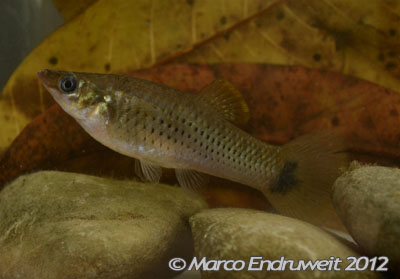
The first poecilid I caught: Poeciliopsis gracilis, male, Bartolo location

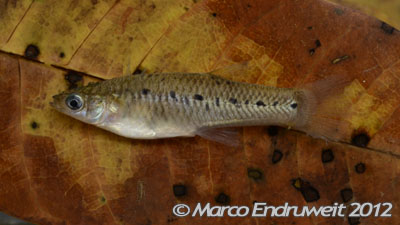
The corresponding female of Poeciliopsis gracilis, Bartolo location

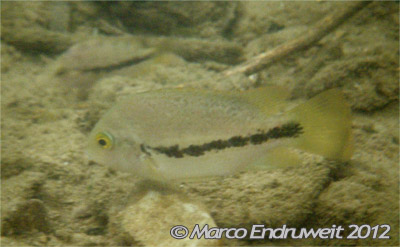
Heterandria bimaculata was ubiquitous; at virtually any location I found this species. Picture shows a male.

An Anura tadpole of a yet undetermined species.

E-MEX 02-09  La Central

Location

Nameless restwater of a small, Pacific slope, running from left to right of the road, served as cattle water tank, ca. 3 km after La Central towards El Fortin, unpaved gravel road, Pijijiapan County, Chiapas Province, Mexico

GPS coordinates

9 m asl, N 15º42.427', W 93º18.947'

Date

2009-02-05

Time

11:25

Biotope

small stream alternating with pools, slow water movement, max. 2 m broad, 50 cm deep, no aquatic vegetation, sand, muddy bottom (from 40 cm depth on) partially densely covered with leaf litter, low turbidity

Parameters

Temperature

24

ºC

pH

7.2

pH

Conductivity (EC)

170

µS/cm

Hardness General

ºGH

Hardness Carbonate

ºKH

Nitrite

mg/l

Total Dissolved Solution (TDS)

80

ppm

Species

Astyanax mexicanus (De Filippi, 1853)

plenty, pelagic

Poecilia sphenops Valenciennes, 1846

plenty

Remarks

Plenty of freshwater shrimps

Biotope E-MEX 02-09
Astyanax mexicanus E-MEX 02-09
Poecilia sphenops E-MEX 02-09

This biotope is located half way from the major highway to the Pacific coastline. It’s a small stream which contributes to a system which finally empties into the Pacific. 

Partially dense canopy coverage and the slow water movement mediates a layer of leaf litter accumulated on the sandy-muddy bottom. 

Livebearing Poecilia and the tetras Astyanax were rather frequent.

Astyanax mexicanus E-MEX 02-09, probably the most frequent tetra in Mexico, usually iving a small shoals of up to 10 individuals.

The landscape around biotope E-MEX 02-09 was arid and of a savanna type. Fields are used a cattle pasture.

Landscape around Biotope E-MEX 02-09

Poecilia sphenops E-MEX 02-09. Picture shows a young female. Also a very common species in southern Mexico.

E-MEX 03-09  El Fortin

Location

on the road La Central - El Fortin, ca. 2 km before El Fortin, unpaved gravel road, artificial nameless brackish water channel, Pacific slope, Pijijiapan County, Chiapas Province, Mexico

GPS coordinates

13 m asl, N 15º38.895', W 93º22.537'

Date

2009-02-05

Time

12:45

Biotope

brack water channel apparently without permanent (?) connection to the sea, due to strong wind some surface water movement (waves), channel L-shaped 500 x 300 m, max. 5 m broad, 80 cm deep, no aquatic vegetation visible, mangroves; mud, sand on the bottom; high turbidity

Parameters

Temperature

28

ºC

pH

8.1

pH

Conductivity (EC)

>1990

µS/cm

Hardness General

ºGH

Hardness Carbonate

ºKH

Nitrite

mg/l

Total Dissolved Solution (TDS)

ppm

Species

Anableps dowei Gill, 1861

plenty

Poecilia butleri Jordan, 1889

abundant

Cichlasoma trimaculatum (Günther, 1867)

plenty

Dormitator maculatus (Bloch, 1792)

abundant

Remarks

Plenty of shrimps, plenty of piscivorous wetland birds along the mangroves

Biotope E-MEX 03-09
Biotope E-MEX 03-09
Anableps dowei E-MEX 03-09
Poecilia butleri E-MEX 03-09
Dormitator maculatus E-MEX 03-09
Cichlasoma trimaculatum E-MEX 03-09
Egretta thula E-MEX 03-09
Phalacrocorax brasilianus E-MEX 03-09
Egretta caerulea E-MEX 03-09
Road LaCentral-ElFortin
Tyrannus melancholicus

Biotope E-MEX 03-09 at El Fortin is the only brackish water habitat I went to on this trip. The deeply greenish turbid water features rich biodiversity.

Mangroves are a typical vegetation form in tropical to subtropical brackish water environments. 

A single individual of Anableps dowei Gill, 1861. Watch the horizontally divided eyes after which the fishes are named. Anableps possesses a mattress-shaped swim bladder giving them enormous floating. They are using the enormous floating when grazing algae; the fish snaps thick algae thriving on the submerged mangrove roots. Now they are using shift lateral head movements and additionally the floating body to tear the algae off the roots.   

Without a doubt the most beautiful Four-Eye is Anableps dowei Gill, 1861 inhabiting brackish water habitats along the Pacific coastline of Central America. Their are living in shoals grazing on algae which they tear off the roots of mangroves. They shoal swims deep into the mangroves at high tide to conquer new feeding places. When the water retreats at low tide the shoal is following the retreating water level returning into the main channel. The pic shows a small shoal in the main channel at low tide. 

A beautiful livebearer living in the nutrient rich, warm water: Poecilia butleri Jordan, 1889. Thanks to Harro Hieronimus/DGLZ and Michi Tobler for identification.

Read more about this eye-catching species here

The predatory gobiid Dormitator maculatus (Bloch, 1792) is common in southern Mexico.

The first cichlid: Cichlasoma trimaculatum (Günther, 1867) was caught by a local fishermen. 

The rather speciose biotope attracts plenty of piscivorous hunters. Several Snowy Egrets, Egretta thula, family Ardeidae, were hunting along the mangroves.

Another piscivorous bird is the Neotropic Cormorant (Phalacrocorax brasilianus, family Phalacrocoracidae.

The Little Blue Heron, Egretta caerulea, family Ardeidae was also among the avifauna of the El Fortin brack water channel. They were by far not as numerous as the snowy egret. 

I am greatly indebted to Mr. Rüdiger W. Riesch for identifying birds species of my Mexico trip. 

One of the birds living in this arid and hot vegetation is steadily tail whippingTyrannus melancholicus, the Tropical Kingbird. This bird can be frequently encountered. 

Typical tree as an attribute of the landscape when heading back northwards. Among the trees and bushes bird life was abundant.

San Cristobal de las Casas

I arrived in San Cristobal de las Casas late in the night. I took some pictures and spent the night there. There are plenty of well preserved buildings featuring colonial style architecture in San Cristobal de las Casas. This place is worth goirng there even you are not too deep into architecture and colonialism. 

E-MEX 04-09  Ocosingo

Location

on the road Ocosingo - Sushila, nameless stream from right to left, tributary to Rio Jataté, Rio Usumacinta basin, Ocosingo County, Chiapas Province, Mexico

GPS coordinates

19 m asl, N 16º52.138', W 92º00.601'

Date

2009-02-06

Time

11:45

Biotope

small stream accumulating into pool shaped sections, some pools up to 15 m diameter; very slow water movement; stream max. 2 m broad, 20 cm deep, pools max. 16 m diameter and 1 m deep; fishes inhabit pools; green algae polster, hygropilic grass hanging down the bank into the water; bottom: sand, muddy bottom (from 40 cm depth on) partially densely covered with leaf litter; clear water

Parameters

Temperature

17

ºC

pH

8.4

pH

Conductivity (EC)

720

µS/cm

Hardness General

ºGH

Hardness Carbonate

ºKH

Nitrite

mg/l

Total Dissolved Solution (TDS)

360

ppm

Species

Astyanax mexicanus (De Filippi, 1853)

plenty, pelagic, a lot of fry along the shores

Heterandria bimaculata (Heckel, 1848)

few, in the shore vegetation

Remarks

Astyanax mexicanus E-MEX 04-09

This is the largest specimen of Astyanax mexicanus. It is a mature female with 89 mm SL. 

E-MEX 05-09  Sushila

Location

on the gravel road Sushila - San Quintin, nameless stream pouring into a pool from right to left, tributary to Rio Jataté, Rio Usumacinta basin, Ocosingo County, Chiapas Province, Mexico

GPS coordinates

851 m asl, N 16º47.778', W 91º48.590'

Date

2009-02-06

Time

13:45

Biotope

lacustrine pool with connected small stream crossing the road; very slow water movement; dammed stream created a pool 40 m diameter, 1.5 m deep, water flow over dam created small stream; no aquatic vegetation visible; bottom: sand, mud, gravel, leaf litter; slightly turbid water

Parameters

Temperature

20

ºC

pH

8.3

pH

Conductivity (EC)

480

µS/cm

Hardness General

ºGH

Hardness Carbonate

ºKH

Nitrite

mg/l

Total Dissolved Solution (TDS)

240

ppm

Species

Xiphophorus hellerii Heckel, 1848

plenty, pelagic

Procambarus sp.

plenty, hidden in the leaf litter

Remarks

Biotope E-MEX 05-09
Biotope E-MEX 04-09

The bottom was partially covered by snail housings.

Biotope E-MEX 05-09

Biotope E-MEX 05-09 at Sushila is located on the way towards Laguna Miramar. It’s a swordtail habitat. I caught wild Xiphophorus for the first time in my life.

The water was slightly turbid, the bottom covered by leaf litter. At the time of my presence the weather was sunny alternating cloudy with some rain drops.

Xiphophorus hellerii E-MEX 05-09
Procambarus sp. E-MEX 05-09

Beautiful blueish wild swordtails Xiphophorus hellerii; a mature male.

The lion share of the swordtails were covered by melasoms; small spots all over the body and fins.

There were plenty of Procambarus among the leaf litter at the bottom. Some hauls brought up to 4 specimens.

Even the experts were unable to guess the identity of this species.

E-MEX 06-09  Patihuitz

Location

on the gravel road Sushila - San Quintin (last stop before the Laguna Miramar), ca. 2 km before Patihuitz, nameless stream from right to left, tributary to Rio Colorado, which is a tributary to Rio Jataté, Rio Usumacinta basin, Chiapas Province, Mexico

GPS coordinates

856 m asl, N 16º45.376', W 91º45.612'

Date

2009-02-06

Time

14:30

Biotope

small stream crossing the road, riparian primary rain forest, stream completely shadowed; moderate current, palm trees standing in the stream providing refugia in their dense root cluster; max. 3 m broad, 30 cm deep; no aquatic vegetation visible; bottom: no aquatic vegetation visible; extremely clear water

Parameters

Temperature

20

ºC

pH

7.6

pH

Conductivity (EC)

460

µS/cm

Hardness General

ºGH

Hardness Carbonate

ºKH

Nitrite

mg/l

Total Dissolved Solution (TDS)

230

ppm

Species

Xiphophorus hellerii Heckel, 1848

plenty, pelagic

Remarks

Biotope E-MEX 06-09
Biotope E-MEX 06-09

Biotope E-MEX 06-09 located ca. 2 km before Patihuitz headings east had wonderful riparian primary forest. Water was extremely clear.

Aside the road MEX 307 from La Trinitaria towards Lagunas de Montebello there is highland pool which possesses an interesting aquafauna. 

Xiphophorus hellerii; a mature female.

E-MEX 07-09  Santa Rita

Location

on the road MEX 307 La Trinitaria - Lagunas de Montebello, towards East, ca. 300 m before village Santa Rita, ca. 10 km after La Trinitaria, on both sides of the road, Chiapas Province, Mexico

GPS coordinates

1536 m asl, N 16º08.472', W 91º58.440'

Date

2009-02-07

Time

11:00

Biotope

highland pool, various pools in a row, not connected for the moment but certainly in the rainy season, standing water, shore very steep, major pool max. 6 x 4 m, 1.5 m deep; no aquatic vegetation visible, hygrophilic grass hanging from the banks; bottom: mud, loam, leaf litter; greenish water of medium turbidity

Parameters

Temperature

16

ºC

pH

8.1

pH

Conductivity (EC)

820

µS/cm

Hardness General

ºGH

Hardness Carbonate

ºKH

Nitrite

mg/l

Total Dissolved Solution (TDS)

410

ppm

Species

Poeciliopsis hnilickai Meyer & Vogel, 1981

abundant

Poecilia sphenops Valenciennes, 1846

few

Profundulus labialis (Günther, 1866)

rare

Procambarus acanthophorus Villalobos, 1948

plenty

Remarks

Biotope E-MEX 07-09

Leaf litter and drift wood on the bottom. The swordtails I found here seem to be the same form as in the previous biotope.

Profundulus labialis E-MEX 07-09

Poecilia sphenops from Santa Rita; mature male.

Procambarus acanthophorus E-MEX 07-09
Poecilia sphenops E-MEX 07-09

An interesting and rare species caught here is Profundulus labialis. Picture shows a juvenile.

Poeciliopsis hnilickai E-MEX 07-09

Poeciliopsis hnilickai from Santa Rita; mature male. They were rather abundant in this biotope.

Poeciliopsis hnilickai, mature female.

The crayfish Procambarus acanthophorus dwelling on the leaf litter covered bottom.

Thanks to Chris Lukhaup for identification of this species.

Thanks to Michi Tobler for identification of this species.

Thanks to Michi Tobler for identification of this species.

Forest_Lagunas_de_Montebello_pic02_400px
Forest_Lagunas_de_Montebello_pic03_400px

The National Park around the Lagunas de Montebello featuring residual primary rain forest. You can stroll through the forest on some paths or take a refreshing bath in one of the Lagunas.

Laguna de Tziscao

The Laguna de Tziscao belonging to the Lagunas de Montebello. Unfortunately the weather was bad. Hence, the pictures are not as brillant as they should be.

Road MEX 175 Lagunas de Montebello-Ixcan

When traveling in Chiapas province, southern Mexico you will certainly encounter some collapsed road, like the highway MEX 175 Lagunas de Montebello towards Ixcan (towards east).

E-MEX 08-09  Rio Acapulco

Location

Rio Acapulco. Not on road MEX 307 Lagunas de Montebello - Ixcan, but next to. Leaving MEX 307 to the right towards, Rio Acapulco Ecotourism Center on a gravel road ca. 1 km after Zacatecas towards Rancheria Capulco/Santa Marta, gravel road crosses Rio Acapulco ca. 400 m after the fishing spot, Rio Acapulco is a tributary to the Rio Lacantύn, Rio Usumacinta basin, Chiapas Province, Mexico

GPS coordinates

1339 m asl, N 16º06.809', W 91º30.974'

Date

2009-02-07

Time

15:00

Biotope

River with strong current, secondary riparian vegetation, trees along the shore on both sides, secondary riparian vegetation, trees along the shore on both sides; no aquatic vegetation, shores with hygrophilic grass; bottom: no aquatic vegetation, shores with hygrophilic grass; no aquatic vegetation, greenish water, clear

Parameters

Temperature

19

ºC

pH

8.5

pH

Conductivity (EC)

320

µS/cm

Hardness General

ºGH

Hardness Carbonate

ºKH

Nitrite

mg/l

Total Dissolved Solution (TDS)

160

ppm

Species

Xiphophorus hellerii Heckel, 1848

abundant

Heterandria bimaculata (Heckel, 1848)

rare

Remarks

Biotope E-MEX 08-09
Biotope E-MEX 08-09

Rio Acapulco is a nice fishing spot. It leads white clear water. Plenty of local women washed clothes in the stream. Current was strong. 

Xiphophorus hellerii E-MEX 08-09

The Mexican military used this spot to clean equipment. They showed up with two hummers, drove into the stream ... hard to suppress photographing.

Finally the sweating gringo succeeded; along the banks there were abundant blue Xiphophorus hellerii, a mature male. 

Blue Xiphophorus hellerii, a mature female from Rio Acapulco.

Biotope E-MEX 09-09
Poecilia sphenops E-MEX 09-09
Rio Santa Elena
Rio Dolores
Rio Santo Domingo
Rio Ixcan
Road MEX 307 Ixcan - SantaRita

E-MEX 09-09  Laguna de Santa Marta

Location

On the same gravel road like E-MEX 08-09 Rancheria Capulco - Santa Marta, ca. 1 km north of Santa Marta, cattle water tank, not visible from the road, need to surpass 4 cattle fields to the right, Laguna de Santa Marta, Rio Usumacinta basin, Chiapas Province, Mexico

GPS coordinates

738 m asl, N 16º06.496', W 91º30.588'

Date

2009-02-07

Time

15:30

Biotope

Lake without connection to a riverine environment at the moment of the visit, but should be linked to the Rio Acapulco, floodplains in rainy season, very shallow shores around the lake, max. 100 x 50 x 2 m deep; no aquatic vegetation visible, hygrophilic grass growing into the water; bottom: sand, mud; water: highly turbid, whitish

Parameters

Temperature

20

ºC

pH

8.2

pH

Conductivity (EC)

220

µS/cm

Hardness General

ºGH

Hardness Carbonate

ºKH

Nitrite

mg/l

Total Dissolved Solution (TDS)

110

ppm

Species

Oreochromis aureus (Steindachner, 1864)

abundant

Cyprinus carpio Linnaeus, 1758

plenty

Poecilia sphenops Valenciennes, 1846

few

Remarks

One of the two kids led me to this spot; biotope E-MEX 09-09 is s rest water lake located far away from any road. You need to find a path over some pastures, climbing over fences, avoided the grazing bulls ...

At the spot there was no aquatic vegetation visible. The entire setup was scaringly silent. I decided not to stay too long but test the water, check the catch of two local fishermen and leave after taking some photographs.

The catch of the fishermen was rather disillusioning; allochthonous Oreochromis and Cyprinus.

I am not 100% sure, but it should be common Poecilia sphenops.

Leaving Santa Marta I need to pass a couple of beautifully wild rivers ... all of them unique for themselves.

The pic shows Rio Santa Elena.

Shortly after that: The calmly meandering Rio Dolores.

The Rio Santo Domingo belongs to the torrential streams. Unfortunately the weather was rainy, hence, the photograph not as brilliant it could be.

The Rio Ixcan also possesses strong current. I did not fish here. There are surely some rheophilic livebearers and cichlids out there.

The following night I spend in my car. It was close to the Mexican-Guatemaltecan border which is famous for drug trafficking.

Military police stopped me from time to time to search my car. The picture shows next mornings sunset in the wilderness.

I was not really prepared to fish a broad river like the Rio Acapulco. But the banks seemed to be promising. I slipped into my water proof rubber pants, the muggy weather led me sweating immediately. When I approached the river the girls on the other side washing clothes were screaming and laughing. Two kids showed up curious for what I am doing in the river. Probably they seldom see a gringo wading the Rio with the water up to the belly button trying to catch small fish instead of big ones. 

E-MEX 10-09  La Union

Location

on both sides of the road MEX 307 Santa Rita - Nuevo Orizaba (military camp and gas station), ca. 3 km after the, village La Union, Rio Usumacinta basin, Chiapas Province, Mexico

GPS coordinates

183 m asl, N 16º04.978', W 90º45.023'

Date

2009-02-08

Time

08:00

Biotope

pools on both side of th road connected via a drainage tube, very slow current from the left to right (of the road), actually standing water, shore steep and shallow alternating, 1 side shady, the rest exposed to direct sun light, pool on the left max. 35 x 25 x 2 m deep; no aquatic vegetation visible, hygrophilic grass hanging from the banks and growing in the water; bottom: thick mud (40 cm), sand, gravel mix; highly turbid water